
Code Index
Brand-scoped code-index reads for repository orientation, directory trees, stored files and symbols, pre-write existence checks, imports, callers, and the tests a change can break, per-directory parse fidelity, and the project's index jobs.
Give your coding agent eyes. Before it fixes a bug or builds a feature, it needs to find where the work belongs. I use Code Index to help an agent locate existing functions and see their indexed connections before it decides what to write.
For a scheduled-report feature, the agent can search for an existing report builder, inspect a matching function and check its indexed Python callers. It then reads the relevant source to decide whether reuse fits. Code Index supplies context; your coding agent does the coding.
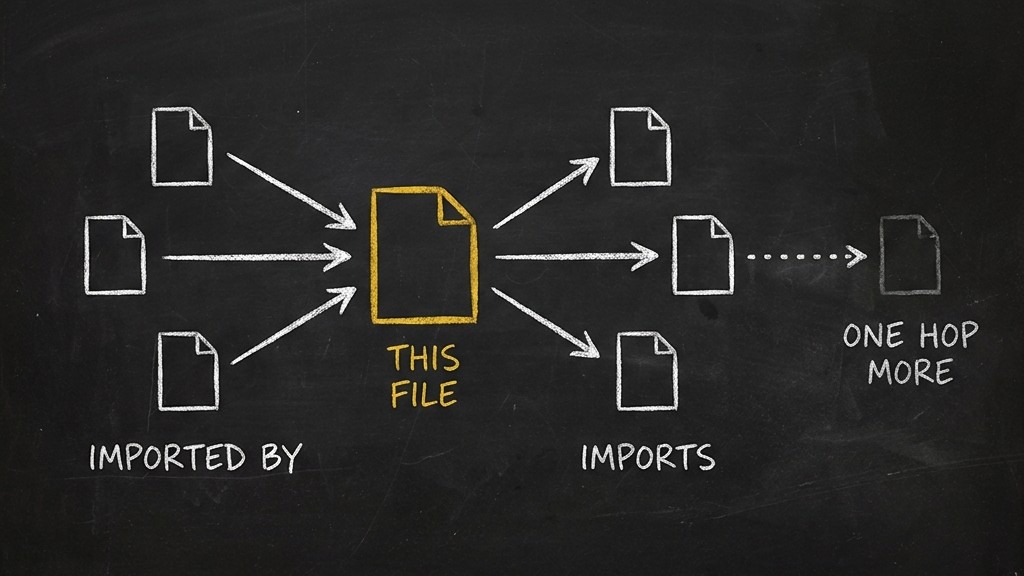
The skill offers 13 read methods for repository summaries, files, symbols, imports, callers, test hints, history, parse quality and index jobs. Import maps cover 3 languages: Python, TypeScript and JavaScript. AgentBoard supplies the project ID that selects the repository.
Every answer describes an indexed commit. Check freshness and parse quality before trusting it. Callers are indexed for Python only; unknown callers are not zero, and heuristic matches can be wrong. Test hints are a starting point, not coverage. Install @opvs-ai/code-index when your agent needs to find existing code before changing it.
Features5
Search for a function or concept before your agent writes it again.
Inspect Python callers and their evidence before changing a function.
Follow stored imports across Python, TypeScript and JavaScript.
Check commit freshness, parse quality and index-job status.
Find test files linked to a change; treat the result as a selection, not coverage.
Videos1 video
DemoCode Index · Demo video
Demo · SpiderMediaArticles about Code Index1 article
Videos1 video
DemoCode Index · Demo video
Demo · SpiderMediaArticles about Code Index1 article
Showing all 1
SKILL.mdthe file your agent reads
SKILL.md loads when you open this tab.
What's new12 releases · newest first · from the package's CHANGELOG
v0.7.22026-11-13Latest
### Changed

- Reuse the approved launch-film hero and three panels on the marketplace card.
- Rewrite listing copy around finding existing code, indexed Python callers and commit freshness.
- Keep the existing launch film. No skill, API or permission change.
v0.7.12026-11-12
The marketplace listing shows the launch film. No skill change.
v0.7.02026-11-11
### Added

- `getFidelity` (`GET /{project_id}/fidelity`) — per directory, how many
  symbols were fully parsed and how many were only regex-matched, counted over
  the directory and everything beneath it. Optional `branch`. JSON only.
- `listIndexJobs` (`GET /{project_id}/jobs`) — the project's index jobs,
  newest first, with `status`, `reason_class` and `detail`, plus the
  `precondition` that stops a new job being queued. `limit` (1–100, default
  25), `offset`, `format=yaml|md`. Read-only: agents cannot start, claim or
  finish a job.

Both use the same `code.index.read` entitlement and `code:read` PAT scope as
every other method; no route changed (SP-46).v0.6.02026-10-28
### Added

- `testsFor` (`POST /{project_id}/tests-for`) — list the test files that can
  reach up to 200 repo-relative files through stored `import` and `reads`
  edges, nearest first, with `hops` and `edge_kinds` per test. Same
  `code.index.read` entitlement and `code:read` PAT scope as every other
  method. Body: `paths` (1–200, each at most 1024 chars), `depth` (1–6,
  default 4), `limit` (1–500 per path, default 200); `format=yaml|md` is a
  query parameter. The route fails open: with no ready index it answers 200,
every path `known: false`, and the reason in `degraded`.v0.4.12026-10-11
### Fixed

- `listFiles` now exposes the API's `order=symbols|path` selection and
  repo-relative `after` cursor. Use `order=path` and pass the last returned
  path as `after` to page through large directories.
v0.4.02026-10-11
### Added

- `getGraphFolders` (`GET /{project_id}/graph/folders`) — read the folder-level
  import map beneath a repo-relative directory: which folders import which,
  which files are hubs, and which import each other. Joins the skill under the same
  `code.index.read` entitlement and the same `code:read` PAT scope (D52).
  Parameters: `dir` (the route's wire name, exposed via `Query(alias="dir")`;
  a dot is the repository root; max 1024 chars), `depth` (1–10, default 2),
  `limit` (positive; the server clamps it), `branch` (max 255 chars), and
  optional `format=yaml|md`. The response reports `truncated`,
  `limit_clamped`, and `effective_limit`. Edges are imports only (Python and
  TS/JS, D43): no Go edges and no call edges; `indexed: false` means "no
  ready index", never "no imports".
- `SKILL.md` adds a short section on what to do when OPVS cannot answer: if a
  call 5xxs, times out, or cannot connect, the agent carries on WITHOUT the
  index (reading the repository or using the handbook), does NOT retry in a
  loop, and says ONCE in its reply that the code index was unavailable. A 4xx
is not this case — a 4xx is a wrong call, and the agent fixes the call.v0.3.32026-10-05
### Added

- `listNodeChanges` accepts `order=asc|desc` (default `asc`, unchanged) and a `before` cursor for newest-first
  paging; `after` stays valid only with `order=asc`. Reuse `next_after` as `after` for ascending pages or as `before`
  for descending pages. The API side shipped in TCI-153 (#2885); this release makes it visible to agents.
v0.3.22026-10-03
### Added

- `listFiles` and `listSymbols` accept `format=yaml|md`, matching the API's text renderings while JSON remains the
  default when `format` is omitted. Both renderings preserve the selected commit and branch, every returned row,
  and any truncation reason.
v0.3.12026-10-02
### Added

- `getGraph` accepts `format=yaml|md` for a text rendering of the import neighbourhood. JSON stays the default when
  `format` is omitted. The yaml and md renderings carry every field the JSON does, including each neighbour's edge
  `kind`, `truncated` and `limit_clamped`.
v0.3.02026-10-02
### Added

- `getGraph` (`GET /{project_id}/graph`) — read the depth-1 or depth-2
  IMPORT neighbourhood of one stable node (`direction` is `in`, `out`, or the
  default `both`; `depth` is 1 or 2). Joins the skill under the same
  `code.index.read` entitlement and the same `code:read` PAT scope (D46).
  Edges are imports only (Python and TS/JS, D43): there are no Go edges and
  no call edges. Each neighbour carries `state` (`live`, `removed`,
  `moved`), `kind: "import"`, and `derivation` (`parsed` or `regex`). The
  route does not render `format=yaml|md`, so the schema declares no `format`
  parameter (per the format-dial test). `limit` is positive and the API
  clamps it; the response reports `truncated`, `limit_clamped`, and
`effective_limit`.v0.2.02026-10-02
### Added

- `resolveNodes` (`POST /{project_id}/nodes/resolve`) — batch-resolve stable
  code anchors against the ledger; one `live | removed | moved | unknown`
  verdict per anchor, with `moved_to_anchor` and `fallback: "file"`
  follow-on fields. `format` is declared `in: query` so the runtime does not
  forward it as a body field that `CodeNodesResolveRequest` (extra="forbid")
  would reject as a 422.
- `listNodeChanges` (`GET /{project_id}/nodes/changes`) — page the attached
  branch's appended node events, oldest first, with `after` as the cursor
  and `history_skipped_reason` exposed when history is not being recorded.
  Adds `node_id` (a list of up to 100 stable node UUIDs) and `path_prefix`
(a repo-relative path, max 1024 chars) as filters, mirroring TCI-122.v0.1.02026-09-29
### Added

- Initial read-only marketplace skill with tree, summary, files, symbols, and
  context-search methods.