Skill Launch Video Factory
Local staged factory for published-skill chalkboard video preparation, approved assets, HyperFrames production, verified delivery and optional authorized distribution checks.
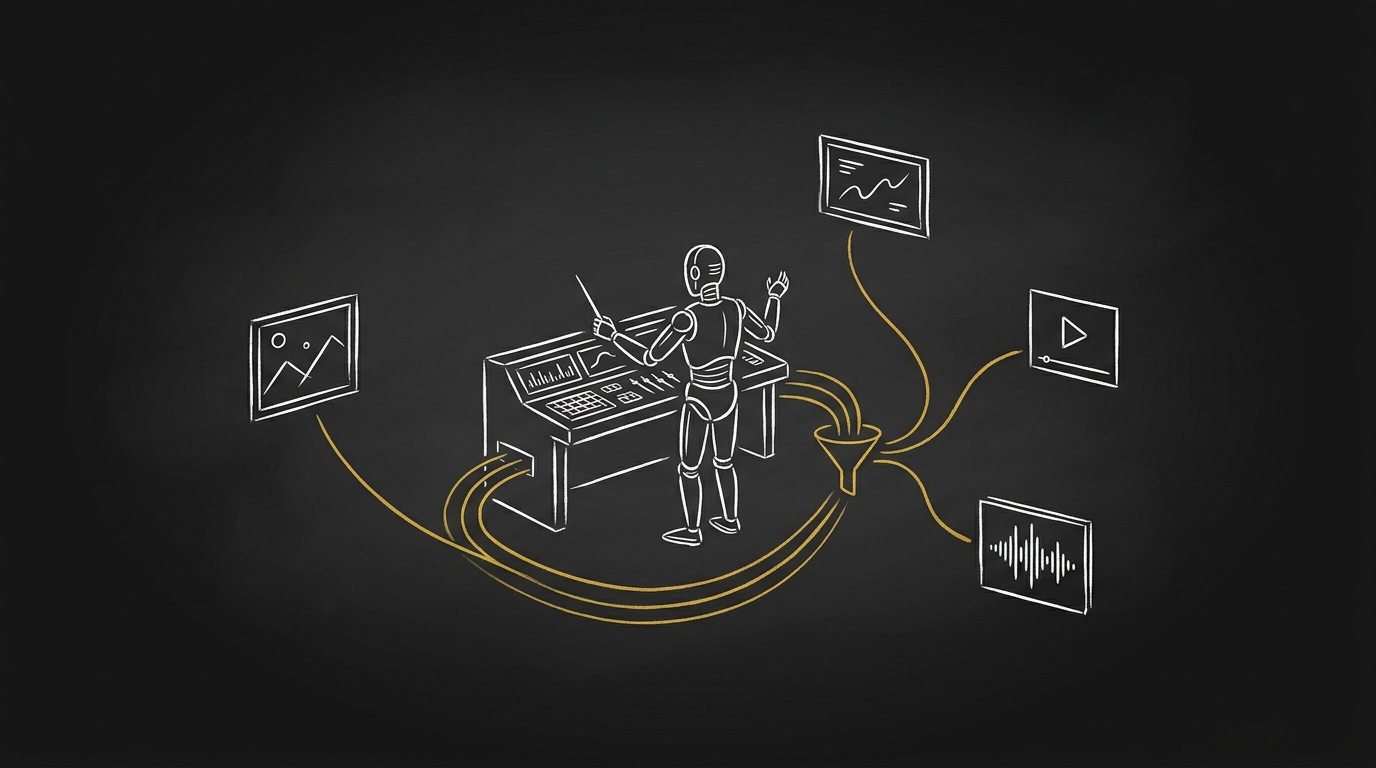
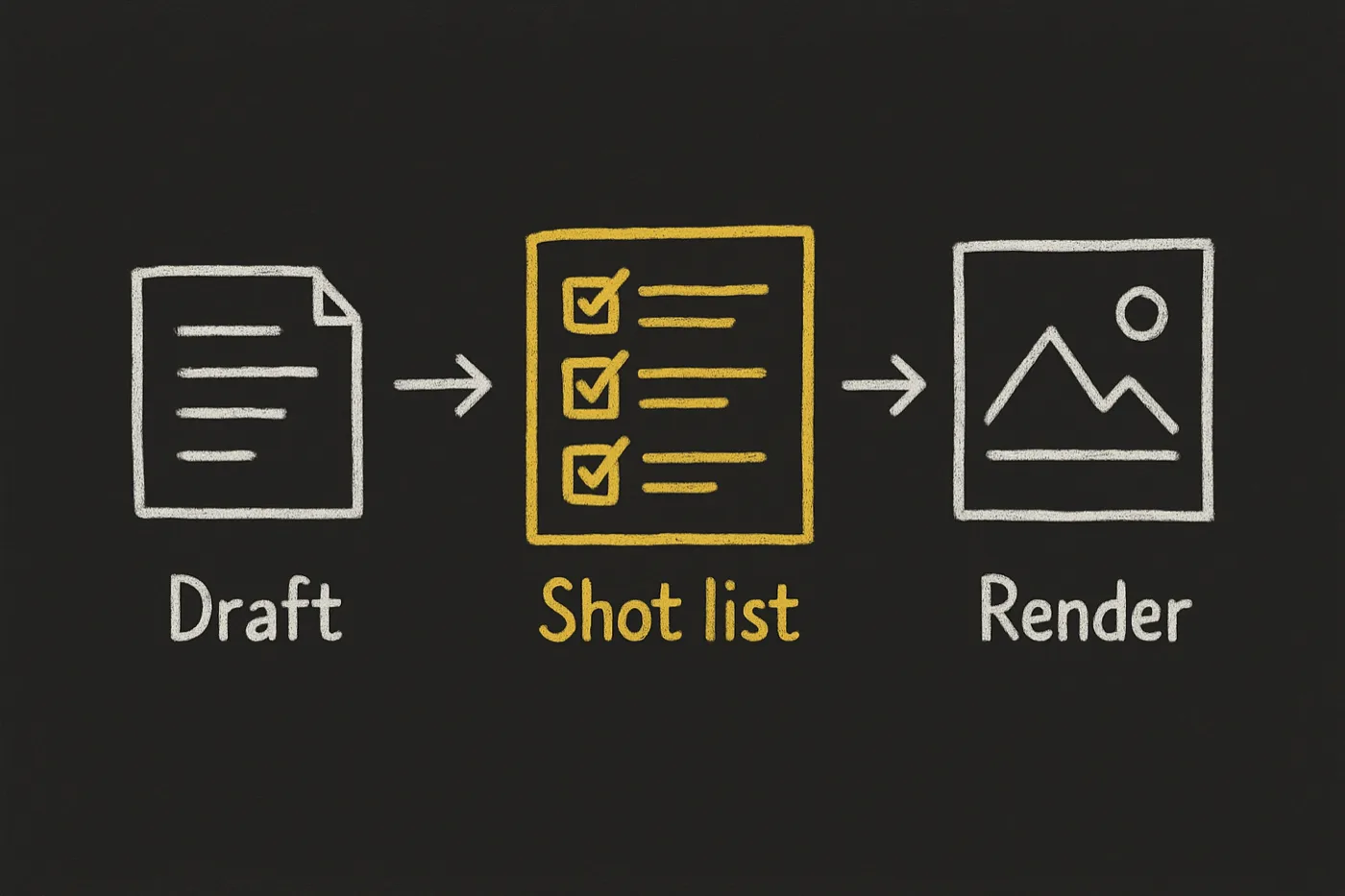
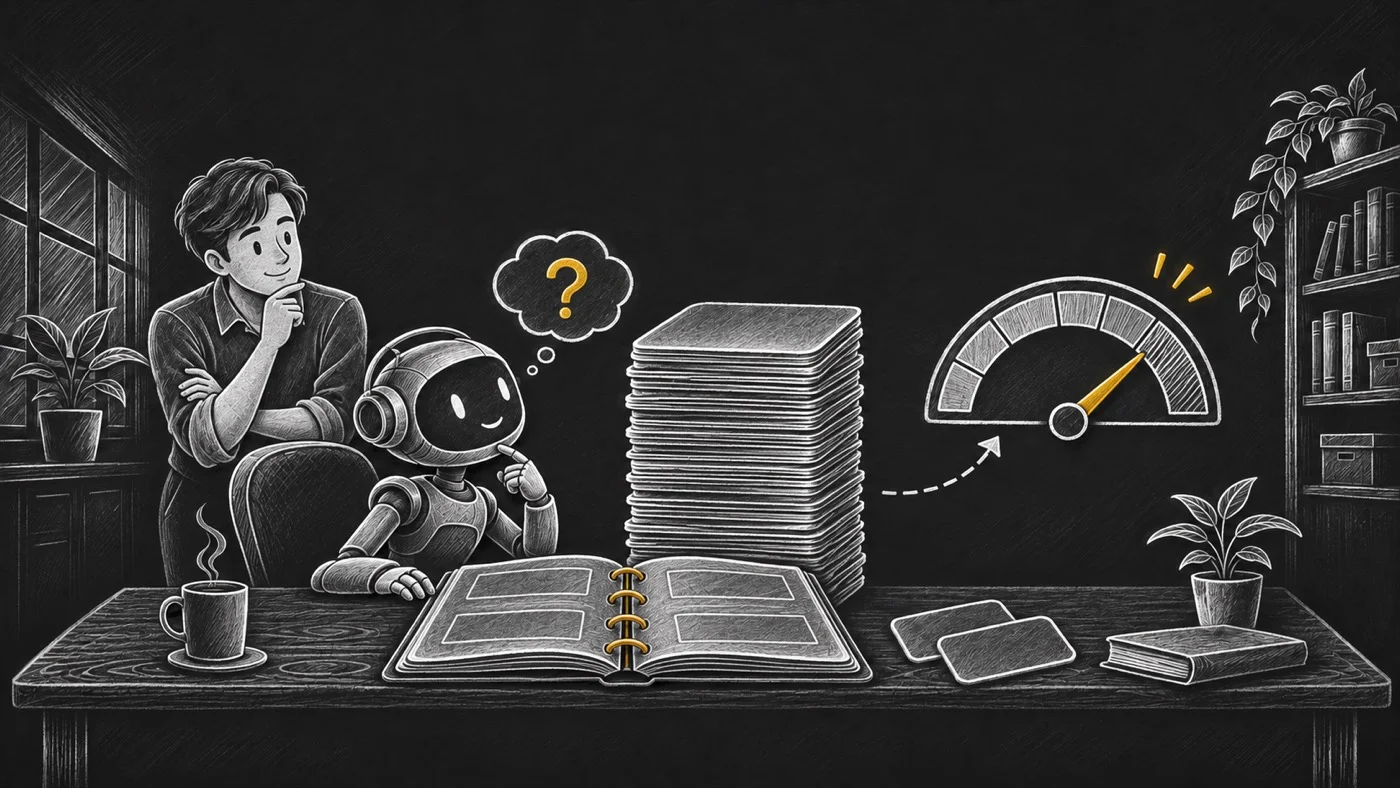
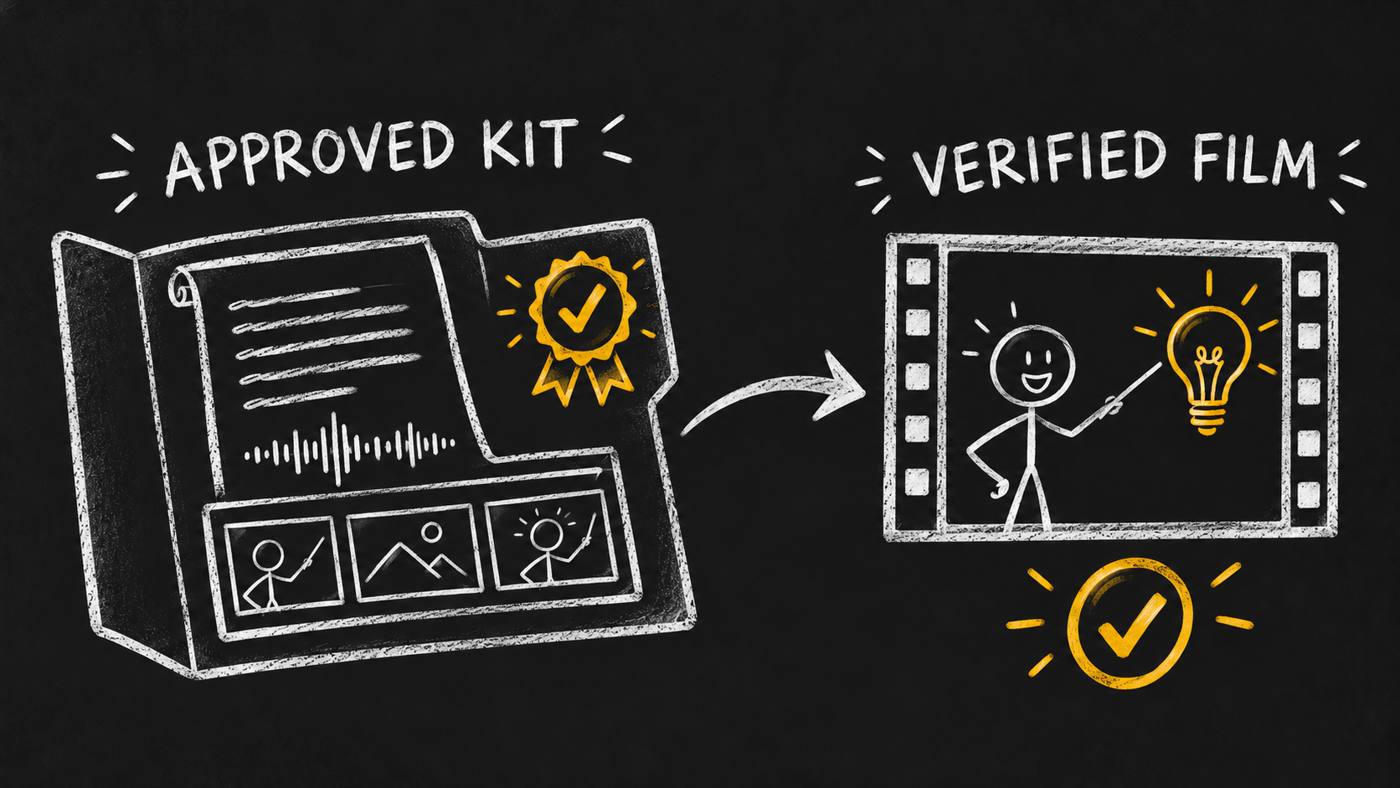
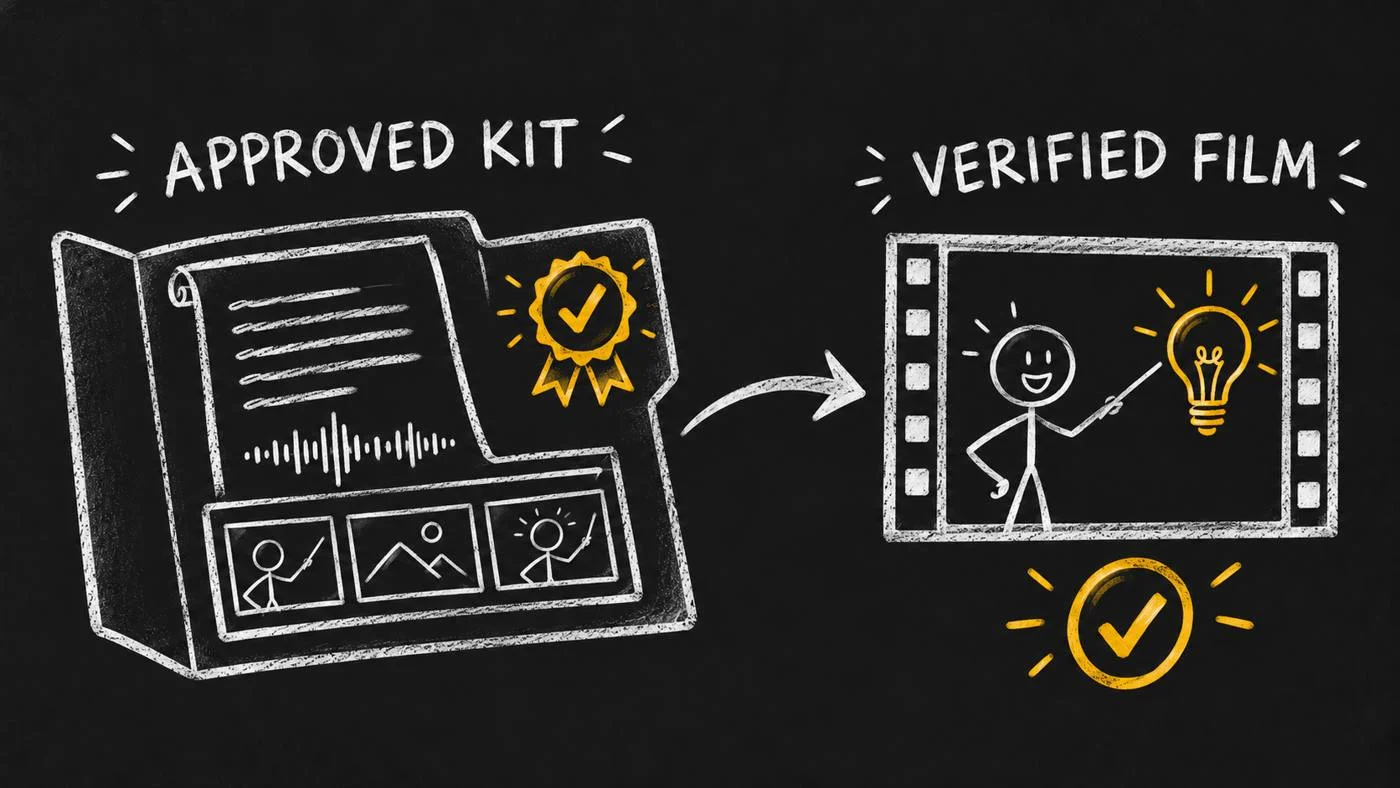
I take a published skill through Analyze, Angle, Story, Content, Video and optional Publish, each step in its own fresh chat that starts from a short brief read off the film folder, so no chat re-reads the whole film. The agent starts with source claims and real buyer pain, gets the angle and story approved, then makes a style sample and one illustration per scene. Recorded voice sets the motion clock. Moving elements are made from approved scene art during Video, checked against the actual mounted files, rendered one film at a time, finished in one house-preset pass, delivery-checked before the approver is asked, and shown with the final film. The checks reject scene pictures used as animation, stale renders, blur, unqueued upload receipts and listing patches that alter more than version, CHANGELOG, the demo link and the packaging repairs the marketplace requires; packaging is checked before the publish approval. A person still judges the story, art and final audiovisual playback. Existing schema 1/2/3 projects keep their pinned runtime. Six films ran on 0.3.0; 0.4.0 fixes their measured faults and has not yet run a real film. No speed or audience outcome is claimed.
Features4
Track Analyze, Angle, Story, Content, Video and optional Publish on one film card.
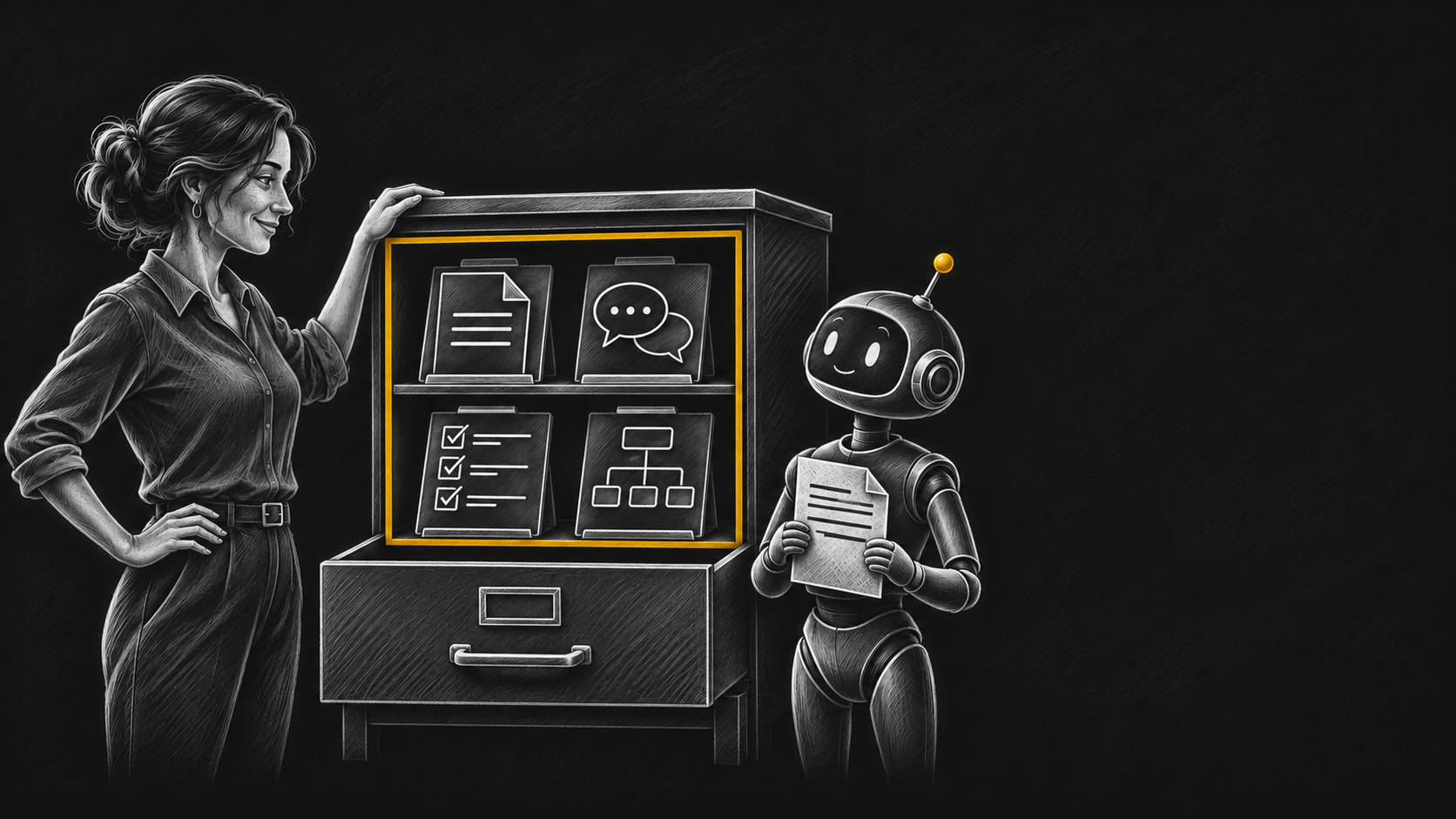
Each step starts from a short brief read off the film folder and ends with the line for the next chat.
Rerun detailed gates and read back exact step evidence from AgentBoard.
Preserve local paths and authorized hosted URLs with the job.
Videos1 video
DemoSkill Launch Video Factory · Demo video
Demo · SpiderMediaArticles about Skill Launch Video Factory1 article
Videos1 video
DemoSkill Launch Video Factory · Demo video
Demo · SpiderMediaArticles about Skill Launch Video Factory1 article
Showing all 1
SKILL.mdthe file your agent reads
SKILL.md loads when you open this tab.
What's new26 releases · newest first · from the package's CHANGELOG
v0.5.112026-11-11Latest
- OPVS copy of the 44-file Di-Atomic 0.5.10 bundle. House record unchanged.
- F: key-free OPVS plan, approved upload/import, clean bundle handoff to LLM14, live readback, and independent draft sync PR. Di-Atomic publishing retained.
- Sprite cast/request/cut route with provenance, geometry/scale checks and visual match sheet; E builder unchanged.
- Signed dry run: LLM14, stage 3. No vendor DAS2-97 fixes in this release.
v0.5.102026-11-10
Marketplace listing update: added the launch explainer film (`media.demo_video_url`). No code, schema, copy or guidance changes; hero and screenshots unchanged from 0.5.9.
v0.5.92026-11-10
Step D refuses music that is near-silent under the first spoken word (DAS2-73 persona-builder, DAS2-74
explainer-illustrations: the same house track rises from -116 dB to -25 dB over its first 1.1 s; with the first
sentence at 0.04-0.06 s the Editor's ducking check read 3.4 / 8.3 dB "pump" on sentence 1 only, every other
sentence 0.1-1.8 dB; the same bed started 1.1 s later passed every finish check, pump 1.64).
- verify-d-content measures the bed under the first word against its own median (100 ms windows); more than
  20 dB below = "YOUR FILE audio-plan.json", naming the second where the bed is audible. A D approved before
  0.5.9 keeps its music (the rule checks only a D not yet approved), so running films can adopt.
- Calibration on 25 real film beds: a simple loudness rule cannot predict the Editor's pump result (github-reader
  passed with more near-silence than explainer-illustrations), so the rule is the strict, cheap one: audible
  at the first word. Real controls: explainer bed r3 (failed E) FAIL, its r4 and persona's re-prepared bed PASS.
- Tests: synthetic rising bed FAIL / steady and late-word PASS; D gate test fails on 0.5.8, passes on 0.5.9.
v0.5.82026-11-10
Step E motion check on long films (DAS2-76 linkedin-researcher 78.4 s, DAS2-77 github-reader 84.0 s): the
HyperFrames check samples 300 evenly spaced times and seeks each to the frame at or before it. Past 14.95 s the
spacing is D/299 (0.26-0.28 s), so the fixed r0+0.25 s deadline and 0.18 s staggered "before" orders could not
be seen and failed (motion_appears_late, motion_out_of_order) on a correct picture.
- e_build's motion sidecar now uses the sampler's own grid and frame floor: each deadline is the first sample
  whose frame shows the element fully revealed; an order is asserted only when a sample shows one element and
  not yet the other; anything on screen shorter than the spacing is listed as unobservable (the frame sheet
  still shows it). Short films keep their old deadlines.
- Proof: the real `hyperframes check` (0.9.15) on copies of both films: FAIL as built by 0.5.6/0.5.7,
  ok:true with the 0.5.8 sidecar. Tests from the real numbers.
v0.5.72026-11-09
Step B starts with why (Martin, 2026-11-09, films DAS2-70..79/93: "they are picking a detail from the skill
and this is wrong"). A launch film sells a change of WHO does the job: today the buyer does it themselves or
pays someone; now an agent with this skill does it.
- angle.json needs big_picture {job, why, today {yourself, hire}, agent, problem}; every option needs a
  one-line why; options tell that story in an everyday scenario and never pick one feature/recipe/check.
  The B gate refuses an angle without it; the B brief and handoff line show the problem first.
- Step C narration follows the same golden circle (hook = why; pain = do it yourself / pay someone;
  usual_failure = what that costs; difference = the agent with this skill; verified_result = what you get).
  narrative_order keys are unchanged, so no schema migration.
- Tests: an angle without big_picture, without today.hire, or an option without why is refused (both new
  tests FAIL on the 0.5.6 controller, PASS on 0.5.7).
- Step D (DAS2-74 explainer-illustrations: Codex stopped on "music choice absent from its actual mix
  carrier" because the carrier shape was not written down): prepare.md 7 now spells out the carriers
  (music.files; effects.files = room + cue files) and that motion-plan elements list every scene-plan beat
  asset. Both refusals now name the exact field and the missing ids. Proven on a copy of the real film: the
  two data fixes take it to "needs approvals/D.json" with no runtime change.
- Step E (DAS2-71 video-editor, scene S02): a tray box held five item boxes; the tray was listed first, the
  peer gives shared pixels to the earlier element, so four items came out empty and E stopped. e_build now
  cuts nested elements first (front_first: deepest box first, plan order otherwise). Proof on the real S02
  canvas: 6 of 6 layers non-empty, recomposition mean |diff| 0.21 levels; test with a tray, nested note and
  an unrelated hand.
- Films initialized before 0.5.7 keep their approved angle: init now writes production.json
angle_rule=start-with-why and only then does B require big_picture (so running films can adopt 0.5.7).v0.5.62026-11-09
From film DAS2-95 (changelog-writer 0.2.0): its live package.yaml has no media: block, so execute stopped with
CANNOT after the upload and PeerTube import, at the step that adds demo_video_url.
- final_manifest_text adds `media:` holding only the link when the package has none (several media: lines stay
  CANNOT); verify F treats a media block that holds only the link as the link.
- The plan now tries the link insertion on the candidate BEFORE the approval request, so this class of stop
  cannot happen after an upload again.
- Proof on the real DAS2-95 files: candidate + the real PeerTube link changes package.yaml by the link only, and
  publish.sh --carry-live --dry-run on that final bundle PASSES. Of the 21 queue skills only changelog-writer
  lacks the block. Test: block added, ambiguous blocks still CANNOT.
v0.5.52026-11-09
Step F repairs an OLD live bundle in the same patch, and checks the vendor's own publish gate before asking
(DAS2-90 podcast: upload, PeerTube import and final bundle passed, then publish.sh refused the 0.1.3 base:
a workbench source/ folder and a verify-coordination.mjs whose shared helper was never vendored).
- The plan applies the repairs patch_delta already allowed, plus vendoring: drop cache/workbench files (root
  source/, tests/, BRIEF/PLAYBOOK notes); beta skills[] visibility -> public; marketing.author from the vendor
  route's vendor-author.json when absent; a verify-coordination.mjs importing a helper that is not beside it gets
  the vendor's helper beside it and the vendor's canonical wrapper (vendor-scripts.mjs semantics). Every repair is
  listed in the plan the person approves; the vendor files are copied into publish/vendor/ and pinned by hash.
- Before the approval request, the plan runs `publish.sh <candidate> --carry-live --dry-run` (sends nothing) and
  stops on its refusal. Measured on the 5 live bundles that fail today's packaging rules: podcast, community,
  distribution-launcher, url-utils, changelog-writer all PASS the real dry run after the repairs (changelog-writer
  loses only BRIEF.md + tests/; its 7 content folders are carried unchanged).
- Re-plan after a refused publish: when an execute uploaded and imported but never published, a new plan (after
  recover F) reuses that upload + PeerTube video, archives the old run under publish/superseded/<time>/, and says
  so in the plan; verify F accepts the earlier upload time only for the upload the approved plan names, with the
  same bytes. A publish that may have been sent still blocks any re-plan.
- Tests: 7 new in test_f_run.py (gate refusal; re-plan reuse -> one upload, one import, verify F PASS, and a
  wrong upload time FAILs it; in-flight publish refuses a re-plan; manifest repairs on community- and
  changelog-writer-shaped texts; vendoring accepted byte-identical and refused when the helper differs).
- Also from 0.5.4: the next-chat line names the film card.
v0.5.42026-11-09
The next-chat line printed by init, advance and approval-request names the film card first (Martin: every spawn
prompt carries the card id): `Use the skill-launch-video-factory skill on card DAS2-89: film <folder>, step D.`
It reads card_ref from production.json; a film without one keeps the old line. test_flow_v4 checks the new line.
v0.5.32026-11-09
From film DAS2-92 (distribution-launcher 0.3.2, the first film with music through the automatic step E):
- Step E's ducking check measured the UNPREPARED edit plan (raw music at -23.22 LUFS, no house volumes) after
  finish.mjs had passed the same check on the plan it actually mixed (prepared music -25 LUFS, music_volume 0.55,
  duck_db -8: balance 8.00 dB, depth 8.01 dB). E could never pass with music. flow_v4 now runs verify-ducking on
  renders/finish-plan.json, only when it is provably the plan that made these finals from this edit plan (edit-plan
  <= finish-plan <= captioned.mp4 in time; same length, voice, picture and caption words; the finish report names the
  approved music as the source of its prepared bed). Otherwise it measures edit-plan.json exactly as before.
- Step D refuses a pronunciation.json naming both "aliases" and "entries" (the chalkboard delivery check refuses it at
  the END of E; DAS2-92 wrote {"entries": [], "aliases": []}).
- Proof on a copy of the real DAS2-92 film: the 0.5.2 controller FAILs the E check; the 0.5.3 controller passes ducking,
  and with the pronunciation file corrected the full E check PASSes. Tests: the binding (control + 4 broken cases:
newer edit plan, other words, other music, a plan made for another folder) and the D rule (control + DAS2-92's file).v0.5.22026-11-09
Step E mounts approved sound effects. In 0.5.1, step D could approve a room bed and cues but e_build stopped
with "build E by hand", which the film brief forbids: film DAS2-90 (podcast 0.1.3) was stuck there.
- Step D states the effects exactly: ONE ambience (room-bed) file, prepared cue files, and
  `effects.cues: [{path, at}]` (the second each cue file starts). verify-d-content refuses selected effects
  without cue times, so the gap shows at D, not at E.
- e_build builds `audio/effects-stem.wav` (film length; room prepared to the house preset -44 LUFS,
  1 s in / 2 s out, looped if short, used as-is if already there; cues placed at their seconds, mixed
  without normalisation), mounts it as the picture's one audio track with the video stream copied, and
  writes `mute: false`, so finish.mjs mixes it at the house effects level. Stem and mount are reused while
  their inputs are unchanged; a new (silent) render is mounted again.
- CANNOT, each broken once in tests: two room files, effects without cue times, a cue path not approved,
  a negative or boolean time, a cue after the film end, a cue longer than 2 s (unprepared library file),
  a cue peaking above -12 dBFS.
- Tests: 8 new in tests/test_e_build.py on a copy of the sales-pipeline film with SYNTHETIC audio made by
  ffmpeg (pink-noise room, sine cue; no library file read). The control proves the stem length, the room
  at -44 LUFS, the cue audible at its second, one audio + one video stream in the picture, and the
  controller's own E checks (mute policy, "selected SFX absent from picture audio route") passing.
  Render and finish stay mocked in these tests, as before; no real film has run on 0.5.2.
- Music tail (from film DAS2-95, changelog-writer 0.2.0): with music selected, step D now requires the film to end
  >= 2.0 s after the last measured word. The Editor's ducking check needs music heard without speech; a
  continuous narration with a 0.21 s tail gave 3 pause windows and FAILED E after the full render and finish.
  2.0 s is the measured passing value (podcast-0.1.3: ducking depth 8 dB, balance 7.99 dB). Every earlier film
  with music had 1.27-2.52 s. Test: control at the real tail passes, one step over refuses.
- Step F uploads a compressed copy, never the master (Martin, 2026-11-09: "why fill SpiderMedia with such large
  files? it's a 1 min video"; a 74 MB master was refused with HTTP 413 on DAS2-88). `f_run.py plan` writes
  renders/captioned-upload.mp4 (H.264 CRF 20, audio copied, faststart) + publish/upload-copy.json proving it is
  the same film: size/rate equal, length within 1 frame, identical audio packets, SSIM >= 0.99, smaller. The
  plan names copy + master, so the F yes covers the uploaded bytes; verify F accepts only a recorded copy of
  the captioned final. CRF 20 on 4 real finals: 28-74 MB -> 8-22 MB, SSIM 0.9914-0.9989 (CRF 23 gave 0.987 on
  two). Tests on 2 real films: control plan+execute+verify F pass; SSIM floor broken once refuses; a tampered
  copy record fails approval-request; a second plan reuses the copy.
- Films started on 0.5.1 keep 0.5.1 (their runtime files are pinned by hash).v0.5.12026-11-09
New films pin HyperFrames 0.9.15 (was 0.8.212). Existing films keep their pin. Measured on a copy of the
finished smartlead film: 0.9.15 renders a picture pixel-identical to 0.8.212 on all 2460 frames, in 17 s
against 18 s, and its `check --json` gives the same contract and the same findings. Details:
`tests/HYPERFRAMES-0.9-NOTES.md`.
- Step F, from the three 0.5.0 test films (DAS2-58..60, 2026-11-05): (1) the embed playback check awaited
  `video.play()` before PeerTube attached the stream; it never settled and timed out at 180 s on a film that
  plays. It now clicks the player's own play button (5/5 plays in about 5 s) and records `started_by`.
  (2) f_run calls publish.sh with `--carry-live` (skill-factory 0.1.21), so a patch of an old live bundle whose
  root predates the clean-copy rule is no longer refused. Tests 13/13; each fix broken once is caught.
- SKILL.md and produce.md name video-editor's finish script as the peer path `$EDITOR_FINISH` (finish.mjs in
  the scripts folder of the `--editor-dir` skill), not a `scripts/` path inside this bundle. OPVS
  test_skill_guide_reachable failed on the old line; the guide now names 4 scripts, all shipped.
- SKILL.md: the init line names `--hyperframes-version 0.9.15`; one line says this skill leads a launch
  film and the HyperFrames skills are reference for the tool, not a second workflow.
- produce.md: the motion sidecar is still required on 0.9.15 (measured); `upgrade --project` does not move
  a film; 0.9.15's own per-account render lock does not replace render-picture.sh's machine-wide one.
- flow_v4.py: comment only, on where 0.8.x and 0.9.x read the browser cache. No code change; the exact
  pin checks in factory.py and e_build.py are unchanged.
- Tests: synthetic fixtures pin 0.9.15; the legacy initializer test stays on 0.8.212; two new self-tests: a
  0.8.212 film still passes on 0.8.212 and is refused when the installed tool is 0.9.15 (fails with the
  version check removed, on purpose).
v0.5.02026-11-04
Steps E and F run from ready commands, so the chat judges and asks instead of working the tool out by
hand. Measured on the 0.4.3 films: E and F each took ~72 model calls and ~9-10 M tokens, mostly reading
this tool's own scripts and other films' folders, then hand-writing JSON.
- `scripts/e_build.py`: writes every E file from the approved D outputs (elements cut from the scene
  boxes or drawn files the chat makes, element sheet, HyperFrames project, edit plan, delivery), renders
  through render-picture.sh, one finish.mjs pass, frame sheet, runs the E checks. Stops with NEEDS when
  the chat must choose boxes, draw an element or write its frame review; re-runs continue. 16 tests,
  known-good control: a real film rewound to D rebuilt and passed the real E checks.
- `scripts/f_run.py plan` writes the exact publish plan and sends nothing; `execute`, only after the
  approval of that exact plan, does permit, upload, import, wait, final bundle, publish, readback and
  receipts in one run. A journal never repeats a send that started without a recorded result. 12 tests,
  known-good controls on two films published with 0.4.3; every guard broken once on purpose.
- Brief: names the two commands and forbids reading the tool's scripts or other films; the Shell line
  is short (it copied the whole PATH and pushed the brief past its size limit, cutting the Board line).
- Both commands are pinned runtime files for new films.
v0.4.42026-11-04
Fixes the step report, found on the first three 0.4.3 films (cro-actions, cro-optimizer, smartlead).
- Step B was CANNOT on all three: Antigravity's own error notices (step 17) broke the token pairing. A stop
  notice ("There was a network issue", "not logged into Antigravity") pairs with a token row only when
  that row is empty; an automatic retry ("API error (attempt 2)") has none. Counted as runtime errors.
- Time the chat sat stopped after such an error is waiting, not working; a call that hung and then
  failed is reported apart as "hung" (one hung 101 minutes).
- Time idle on a background command (render, upload, picture job; Antigravity's "[Message] ... Command
  exited" notice) is shown inside the working time.
- SKILL.md: the PATH line is the first command of every chat, before any preflight or mail check (the
  one 'command not found' left per film came from step A's first command).
- Self-test 26/26; two break-on-purpose controls caught.v0.4.32026-11-04
Fixes the faults the step reports found in all three 0.4.x films (8-11 'command not found', 3-5 board
'unconfirmed', wrong opvs flags, one crash per film), plus Martin's player rule.
- Every tool the controller runs gets a PATH with /opt/homebrew/bin, /usr/local/bin, ~/.local/bin and nvm node first; the brief prints the same PATH line for the chat. The board error now says why (it hid 'opvs not found').
- The brief names the board command (step-status) and says which opvs flags do not exist; step E warns off running Chalkboard's verify-delivery on delivery.json directly (it crashed once).
- B summary names the option the person chose (approvals/B.json selected_option), not the recommendation.
- PeerTube listing link is always the minimal embed `/videos/embed/<id>?title=0&warningTitle=0&peertubeLink=0&p2p=0`; F refuses any other form, before the approval request and after publish. Thumbnail = scene 1 needs a SpiderIQ route (request written).
- Step report: an error shows the line that did the work, not the PATH export.
v0.4.22026-11-04
- Step report at every handoff: `scripts/step_report.py` reads the step's own chat record on the Mac (Antigravity, Codex, Claude Code) and writes `.factory/reports/<step>.json` plus one line on the card: turns, model calls, tokens (new / cached / output / thinking), minutes working vs waiting for the person, failed commands by kind, SKILL DEFECT notes. A chat shared by several steps is cut at the steps' completion times. The last step prints the film total and recurring failures. Never blocks a handoff; CANNOT when it cannot read. Self-test 21/21; checked on 3 real films (step A of cro-audit: 1,896,302 tokens counted, the same total counted independently).
v0.4.12026-11-04
- F: a root entry the signed live bundle already ships byte for byte (and NOTICE.md, upstream licence text) no longer fails packaging. cro-audit 0.2.0 ships an MIT NOTICE.md: 0.4.0 refused keeping it and refused dropping it, so its film could not reach the F approval request (DAS2-52). Test with two break-on-purpose controls.
v0.4.02026-11-03
- One fresh chat per step: `factory-v4.py brief` prints a short start brief from the film folder; each step ends with the one line for the next chat. All "same chat" instructions removed. Images are checked through one contact sheet per check (new `contact-sheet`).
- E: `scripts/render-picture.sh` renders one film at a time on the machine with 10 workers and the real user's HyperFrames cache; Video Editor's one-run `finish.mjs` replaces hand-tuned compose passes; the full delivery check runs inside the E approval request; no ducking check on a no-music plan; the HyperFrames preview cache is ignored.
- F: packaging checked before the approval request, with the repairs packaging needs (visibility, author, cache removal); upload and URL after the yes; direct MP4 and PeerTube URLs each have their own rule; buyer page without a buyer login is recorded as not measured; relative card paths; upload-batch route for large films; hosted-video import recipe. Peer floors: Video Editor >=0.2.0, Chalkboard Explainer >=0.1.2. No real film has run on 0.4.0.
v0.3.02026-11-02
- Add independent schema 4 A–F production with angle/story, style sample, Content, final film and separate Publish approval. Preserve all legacy runtime bytes.
- Make elements from approved scene art during Video; check mounted hashes, layer files, render freshness, blur and current decoded frames before final review. Add explicit visible recovery and one-request timestamped voice helper with a designated external key file.
- Verify exact upload plans and actual live-based film-patch bundles; preserve listing fields and require real playback, human final review and buyer evidence. No real film has run on 0.3.0.

# 0.2.0

- Track six visible film steps on AgentBoard; retain all detailed gates internally.
- Continue the same chat through verified handoffs, pausing for genuine approvals or unresolved failures.
- Add six step verifiers, exact handoff/readback and safe retry; preserve legacy project contracts.
- Pin the coordinator, require rough-cut evidence, refuse populated-card initialization and silent
  reopen of closed steps. Keep generated-media persistence and optional destination authorization.
- Tested synthetic controls and one disposable live board round trip; no real film on 0.2.0 yet.

# Changelog
v0.1.7packaging correction, 1 November 2026
- Remove the stray compiled Python cache file included in 0.1.6. No change in behaviour.
v0.1.6audio and workflow recovery, 1 November 2026
- Add the measured quiet-mix reference and a bounded ElevenLabs effects helper; source or generate cues without private project files.
- New projects use schema 2 with independent sound choices, scoped approvals and an actual style sample approved before scene generation.
- Accept only replay-proven gain/latency-compensated limiter derivatives of the approved voice; preserve sample timing.
- Serialize media/card updates, preserve historical links, and add explicit continuation/activity states and communication-gap diagnostics.
- Bind workflow_support.py alongside the changed controller; no automatic migration of projects already running.
- Reconcile the shipping workflow with the human entry point and remove private production identifiers from buyer files.
v0.1.5announcement media, 31 October 2026
- Add one concept hero and three explanatory panels for the public marketplace card.
- Add buyer-facing long description and feature copy.
- Workflow, controller, peer floors and upload implementation unchanged from 0.1.4.
v0.1.4public beta, 31 October 2026
- Expose the factory at beta/public with Video Editor >=0.1.2.
- Read the media bucket from the first authorized upload; keep workspace/login examples portable.
- Refresh the two-workflow handbook and remove private identifiers, local paths and unavailable internal report links.
- Recheck the media command recipes and upload/readback controls before release.
v0.1.3internal media lifecycle instructions, 31 October 2026
- Register all generated images/audio/video and revisions in one media index throughout both workflows.
- Use SpiderMedia's authorized upload/readback routes; retain separate master/hosted-copy hashes.
- Persist the full media list and every actual URL on the production AgentBoard card using a separate merge/readback, preserving history and unrelated fields.
- Correct the claim that factory checkpoint alone saves hosted-media URLs. Controller/upload code unchanged.
- references/workflow.md: the human entry point and session prompts now ship in the package.
v0.1.2unpublished, 31 October 2026
- references/spidermedia.md: how the propagate stage hosts images, audio and film on SpiderMedia and
  makes the PeerTube copy. Every door run live; audio has its own door, `upload_local_file` refuses it.
- scripts/spidermedia.py: audio upload through the OPVS proxy, hosted-bytes read-back, PeerTube import
  and status. Controller and peer code unchanged.
v0.1.1unpublished pilot-informed instructions, 31 October 2026
- Clarify authorized continuation, actual stage-run identities and the two-workflow boundary.
- Require visual storyboards, asset/camera feasibility proof and scene/seam motion review.
- Document sound revision/revalidation, short-word caption audition and approved-audio preservation.
- Distinguish current decisions, historical evidence, preview types and checkpoint/status health.
- Clarify technical checks versus creative acceptance and peer release requirements.
- Keep controller/peer code and finished production bytes unchanged; new editorial requirements are not new automated checks.
v0.1.0unpublished local build, 30 October 2026
- Add two-workflow stage controller with resume/reopen, project lock, input fingerprints and approvals.
- Gate source claims, measured narration/caption coverage, directed speech beats and scene/element coverage.
- Execute actual Chalkboard, HyperFrames and Editor checks; freeze tool/artifact evidence at handoff.
- Separate approved preparation kit, private ship and exact-scope distribution verification.
- Add synthetic positive/negative controller tests and real historical-media integration checks.